July is Sarcoma and Bone Cancer Awareness Month
join with the aacr to find better ways to prevent and treat sarcoma and bone cancer
Sarcomas are a rare group of cancers in which malignant cells form in the bones or soft tissues of the body.
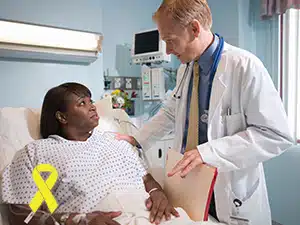
Soft tissue sarcomas form in cartilage, fat, muscle, blood vessels, tendons, nerves, and around joints. Osteosarcomas develop in bone; liposarcomas form in fat cells. Rhabdomyosarcomas form in muscle, and Ewing sarcomas form in bone and soft tissue.
About 22% of bone and joint cancer cases are diagnosed in those under age 20, while soft tissue cancers are more often diagnosed in those 55 years or older.
In 2026, approximately 13,910 cases of soft tissue sarcoma and approximately 4,110 cases of bone and joint cancer are expected to be diagnosed in the United States. That is according to estimates from the National Cancer Institute’s Surveillance, Epidemiology, and End Results Program (SEER). Some 5,400 and 2,210 people are expected to die from soft tissue and bone sarcomas, respectively. The five-year survival rate for soft tissue sarcomas is 65.7%. The survival rate for bone and joint sarcomas is 68.7%.
Because sarcomas are difficult to distinguish from other cancers when they are found within organs, their incidence is probably underestimated, according to the National Cancer Institute.
Having certain inherited disorders can increase the risk for soft tissue sarcomas. These include Li-Fraumeni syndrome, tuberous sclerosis, Werner syndrome, and nevoid basal cell carcinoma syndrome. Other risk factors for soft tissue sarcomas include past treatment with radiation therapy for certain cancers; exposure to certain chemicals, such as thorium dioxide, vinyl chloride, or arsenic; and long-term lymphedema in the arms or legs.
Risk factors for osteosarcoma include past treatment with chemotherapy or radiation, having a certain change in the RB1 gene (also known as the retinoblastoma protein), as well as having certain conditions such as Paget disease, Diamond-Blackfan anemia, Li-Fraumeni syndrome, and Werner syndrome.
One Patient’s StorY
In early 2021, Quinn Johnsen, 31 years old, was diagnosed with synovial sarcoma, a rare and aggressive cancer. As part of his initial treatment plan, he was prescribed a grueling regimen of six cycles of chemotherapy. While the treatment caused him to be hospitalized for two and a half months, it was effective. Quinn had no evidence of cancer for over two years, until a routine scan in June 2024 found the cancer had returned. This time, his physician recommended joining a clinical trial for a novel treatment called afamitresgene autoleucel (afami-cel) that re-engineers a patient’s own immune cells to recognize and attack cancer cells. Quinn’s physician now describes his cancer as “stable.”
“We’re talking about how I can get on with my life, not how to brace for what’s next,” Quinn said. “I am able to work, and my friends would agree that my life has kind of returned to as normal as possible from afami-cel treatment.”
Read Quinn’s story in the AACR Cancer Progress Report 2025.
More on sarcoma and bone cancer
- The investigational treatment that Quinn received was granted accelerated approval by the U.S. Food and Drug Administration in August 2024 under the brand name Tecelra, and was granted full approval in June 2026. Learn more about how this T-cell receptor therapy works, the process patients must go through to receive this treatment, and its survival benefits and sides effects in the the AACR magazine Cancer Today.
- A clinical trial found that people with alveolar soft part sarcoma, a rare cancer that primarily impacts people ages 15 to 35, can continue to receive the approved immunotherapy atezolizumab (Tecentriq) for more than two years without long-term side effects. Learn more in Cancer Today.
- Researchers are examining whether AI can potentially help overcome some of the challenges that come with diagnosing and classifying the exact type of sarcoma a patient has in order to better identify the right therapy for each individual. To learn more, read How Artificial Intelligence Could Transform Care for Children With Sarcoma on Cancer Research Catalyst.
- Julie Kramer was diagnosed with synovial sarcoma at age 23. On Believe in Progress: An AACR Foundation Podcast, she talks about the transformative power of community support and holistic practices like Reiki and yoga.
What the AACR Is Doing in Sarcoma and Bone Cancer Research
The AACR is supporting sarcoma research through these recent fellowships and grants:
- The AACR-QuadW Foundation Sarcoma Research Fellowship in Memory of Willie Tichenor to Md Imdadul H. Khan, PhD, of Case Western Reserve University School of Medicine, in 2026 for his research on the “therapeutic potential of a novel CBP/p300 inhibitor in fusion-positive rhabdomyosarcoma.”
- The AACR-QuadW Foundation Sarcoma Research Fellowship in Memory of Willie Tichenor to Janeala Morsby, PhD, of St. Jude Children’s Research Hospital, in 2025 for her research on “exploring the mechanism of synergy of the dual inhibition of ATM and PARP in pediatric osteosarcoma.”
- The AACR Fellowship to Further Diversity, Equity, and Inclusion in Cancer Research to Madelyn Espinosa-Cotton, PhD, of Memorial Sloan Kettering Cancer Center, in 2023 for her research on “bispecific antibody-based immunotherapy and radioimmunotherapy for desmoplastic small round cell tumors.” Espinosa-Cotton shared more about the “potentially curative” treatments she is researching in a piece for AACR Stories.
for more information
For more information on sarcoma in adults, please see our page on soft tissue sarcoma.
For more information on sarcoma in children and adolescents, please see our page on childhood soft tissue sarcoma.

Your gift helps the American Association for Cancer Research fund pioneering science that is saving lives every day.
Donate Now
There are many ways in which you can lend your talents to support lifesaving research. Learn how you can become an advocate for cancer research, participate in events to raise awareness, volunteer your time, and share your story of how cancer has affected your life.
Get Involved